

PNY GeForce RTX 4090 VERTO Triple Fan
24 GB GDDR6X, PCIe 4.0 x16, HDMI, 3 x DisplayPort, #VCG409024TFXPB1
Price on request
No longer available
AMD Radeon Instinct MI100 Accelerator 32GB
32GB HBM2, PCIe 4.0 x16, Passive Cooling, HF, RoHS 100-506143
Price on request
No longer available
Supermicro Add-on Card GPU-NVTT4
NVIDIA Tesla T4 16GB GDDR6 PCIe 3.0-- Passive Cooling, Single Slot, 70w
Price on request
No longer available
AMD MI100 Infinity Fabric Link Bridge Card 4P Adjacent
100-506116
Price on request
No longer available
NVIDIA Quadro RTX A5500/activ 24GB GDDR6 PCIe 4.0
Ampere-Architektur, PCIe x16 4.0, 24GB GDDR6 ECC Memory, 10240 CUDA Cores, 2-Slot, 4x DisplayPort 1.4a, 1x 8-pin Power Input, 230W TDP
Price on request
No longer available
NVIDIA Quadro RTX 4000 SFF Ada 20GB GDDR6 PCIe 4.0
NVIDIA Ada Lovelace Architecture, PCIe x16 4.0, 20GB GDDR6 ECC Memory, 6144 CUDA Cores, Low Profile 2-Slot, 4x mDP 1.4a, 70W TDP
Price on request
No longer available
NVIDIA Quadro RTX A2000/activ 12GB GDDR6 PCIe 4.0
12 GB GDDR6 PCIe 4.0-Active,, 2-Slot, 4x DisplayPort 1.4, 70W TDP
Price on request
No longer available
NVIDIA Quadro RTX A4000/activ 16GB GDDR6 PCIe 4.0
Ampere-Architektur, PCIe x16 4.0, 16GB GDDR6 ECC Memory, 6144 CUDA Cores, Single-Slot, 4x DisplayPort 1.4, 2x 8-pin Power Input, 140W TDP
Price on request
No longer available
NVIDIA Quadro RTX 6000/activ 24GB GDDR6 PCIe 3.0
Turing-Architektur, PCIe x16 3.0, 24GB GDDR6 ECC Memory, 4608 CUDA Cores, 2-Slot, 4x DisplayPort 1.4, 1x USB-C (VirtualLink), 1 x 8-pin + 1 x 6-pin Power Input, 295W TDP
Price on request
No longer available
Supermicro Add-on Card GPU-NVQGV100
NVIDIA PNY Quadro GV100 32GB HBM2 PCIe 3.0- Active Cooling
Price on request
No longer available
NVIDIA Add-on Card Quadro M2000, VCQM2000-BLK
Quadro M2000 4096MB GDDR5 128bit PCI-E 3.0x16 4xDisplayPort 768 CUDA Cores active
Price on request
No longer available
NVIDIA Quadro RTX A6000/activ 48GB GDDR6 PCIe 4.0
Ampere-Architektur, PCIe x16 4.0, 48GB GDDR6 ECC Memory, 10752 CUDA Cores, 2-Slot, 4x DisplayPort 1.4, 2x 8-pin Power Input, 300W TDP
Price on request
No longer available
NVIDIA Quadro RTX 4000 8GB GDDR6 PCIe 3.0
Turing-Architektur, PCIe x16 3.0, 8GB GDDR6 ECC Memory, 2304 CUDA Cores, 2-Slot, 3x DisplayPort 1.4, 1x USB-C (VirtualLink), 1 x 8-pin Power Input, 125W TDP
Price on request
No longer available
Supermicro Add-on Card AOC-GPU-NVTP40
NVIDIA Tesla P40 24GB GDDR5 PCIe 3.0 - Passive Cooling
Price on request
No longer available
NVIDIA Quadro RTX 4000 8GB GDDR6 PCIe 3.0
Turing-Architektur, PCIe x16 3.0, 8GB GDDR6 ECC Memory, 2304 CUDA Cores, 2-Slot, 3x DisplayPort 1.4, 1x USB-C (VirtualLink), 1 x 8-pin Power Input, 125W TDP
Price on request
No longer available
NVIDIA Quadro RTX 8000/activ 48GB GDDR6 PCIe 3.0
Turing-Architektur, PCIe x16 3.0, 48GB GDDR6 ECC Memory, 4608 CUDA Cores, 2-Slot, 4x DisplayPort 1.4, 1x USB-C (VirtualLink), 1 x 8-pin + 1 x 6-pin Power Input, 295W TDP
Price on request
No longer available
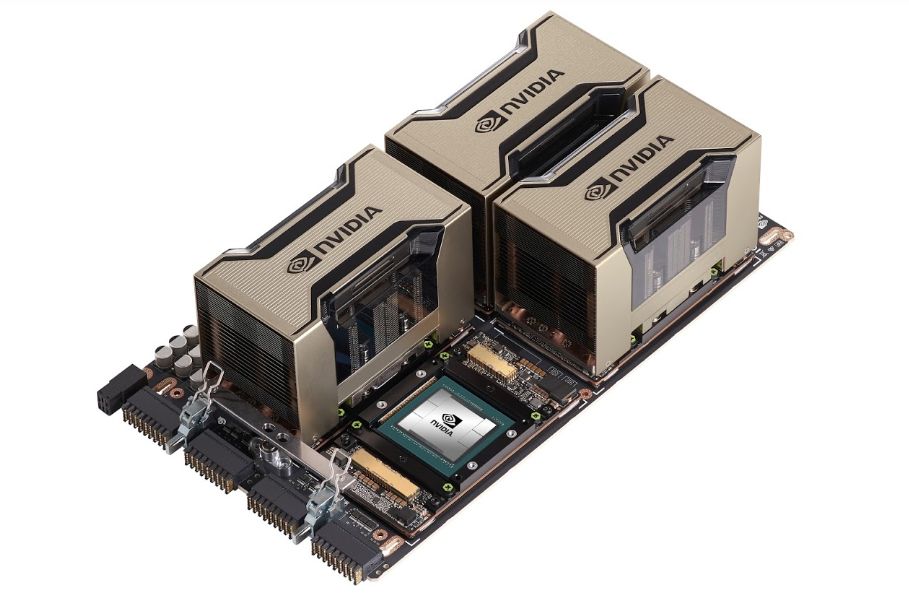
NVIDIA Redstone GPU Baseboard, 4x A100 40GB SXM4 (Complete System Only)
NVLink NVIDIA Tesla A100-40-SXM4 (Ampere) Graphic Computing-Prozessor [GPU], 40GB HBM2, max. 156 Tensor Core TFLOPS Deep Learning, 19,5 TFLOPS Single Precision floating point performance (peak), 9,7 TFLOPS Double Precision floating point performance (peak), 6912 single precision CUDA Cores und 432 Tensor Cores/GPU, Verbindungsbandbreite mit NVLink: 1,555 GB/s, NVIDIA NVLink 600 GB/s, PCIe Gen4 64 GB/s, 400W TDP (typical), passiv, #GPU-HGX A100 4-GPU
Price on request
No longer available
NVIDIA Quadro RTX 5000 16GB GDDR6 PCIe 3.0
Turing-Architektur, PCIe x16 3.0, 16GB GDDR6 ECC Memory, 3072 CUDA Cores, 2-Slot, 4x DisplayPort 1.4, 1x USB-C (VirtualLink), 1 x 8-pin + 1 x 6-pin Power Input, 230W TDP
Price on request
No longer available
Graphics cards - Important Background Information
What You Should Pay Attention to when Buying
The most important questions at a glance- Which graphics chip has been installed?
- How much memory is available?
- What is the clock rate of the GPU?
How did the GPU Come About?
A GPU, also called a graphics processor or graphics processing unit, performs mathematical calculations of data particularly quickly. Graphics-intensive programs, for example in research and development, have increasingly led to the impairment of the central processing unit (CPU) of a server in the past. Accordingly, GPU computing is now a standard for computationally intensive processes. While the CPU performs the traditional computing tasks, the GPU takes over the demanding tasks, thus relieving the actual processor. As a result, companies speed up their work processes and production workflows through better server performance.The Cores of the GPUs and Their Tasks
Modern GPUs break down the actual computing task into several subtasks and process them in parallel. For this purpose, they are equipped with a large number of cores: While CPUs usually have four to 64 cores, the latest GPUs have several thousand cores, which are also divided virtually. Thus, each core can fulfill several tasks.The rapid development of digitization and data processing would not have been possible without powerful GPUs. Whether in the field of medicine, material science, in production or research: engineers and technicians use the parallel working helpers in the servers for their immense calculations of data. As this amount of data to be processed becomes more, not less, in the future, the importance of GPUs increases accordingly.
The Role of GPUs in AI, Machine Learning and Deep Learning
To advance artificial intelligence, companies need to collect and analyze more and more data faster and faster. These highly computationally intensive tasks require powerful GPUs. With thousands of cores and parallel architecture, GPUs process smaller data sets in a matter of seconds instead of four to five minutes by a CPU. For particularly high volumes of data, such as Deep Learning, times are reduced from weeks to days. GPUs developed specifically for AI now manage a computing power of 100 tera floating point operations per second (teraFLOPS). Leading manufacturers are increasingly developing their own GPUs specifically for AI research.If you have any questions, our team of experts will be happy to help you - also when it comes to suitable additional components such as RAM, HDD, SSD or controllers.